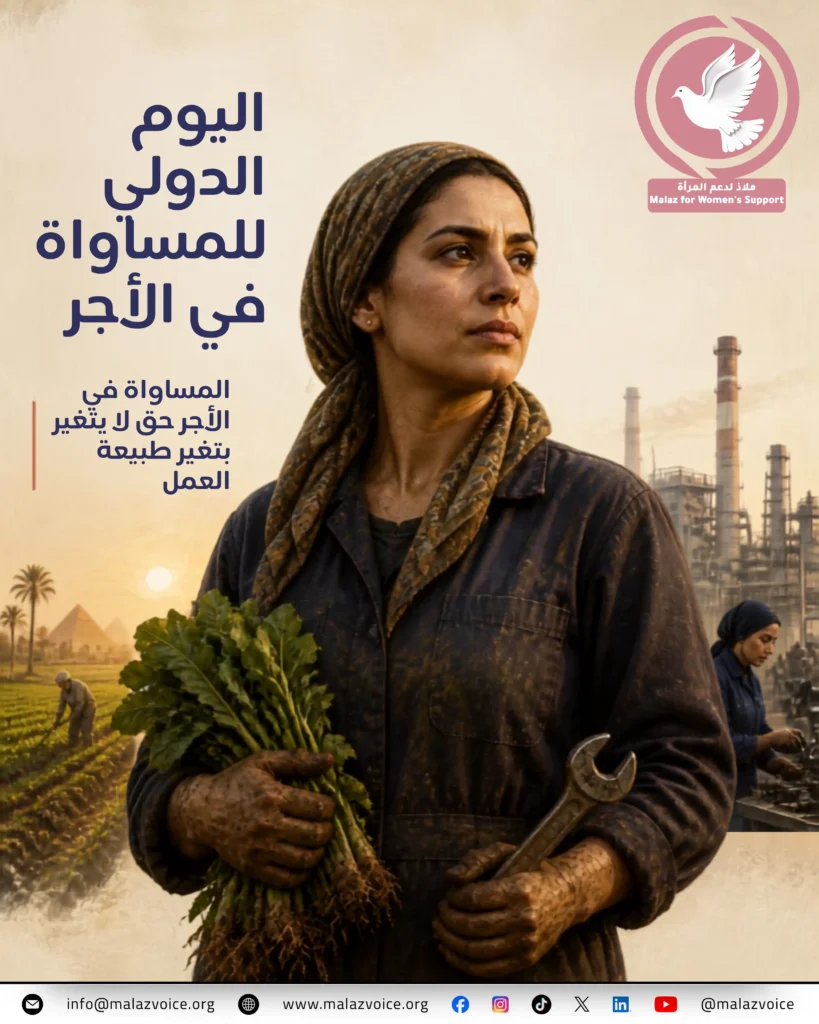
On the occasion of International Equal Pay Day, Malaz Foundation for Women’s Support affirms that the right of women workers to fair remuneration without discrimination is a fundamental right, and that differences in the nature or form of work should not constitute grounds for undermining or diminishing this right.
The Foundation notes that women engaged in daily, temporary, seasonal, and informal work may face additional challenges related to wage determination, establishing the employment relationship, accessing social protection, and accessing complaint and redress mechanisms. Such barriers may further widen the gap between the rights to which a woman worker is entitled and the rights she is able to effectively enjoy in practice.
Equal pay is not limited to formal employment. It extends across different forms of work, including agricultural, industrial, and irregular work, taking into account the nature of the tasks performed, the value of the work, working hours, and the conditions under which work is carried out, without discrimination on the basis of gender.
Malaz believes that addressing pay gaps requires greater clarity and transparency in wage determination, access to information for women workers, strengthened mechanisms for establishing the employment relationship, and accessible complaint, redress, and social protection mechanisms, particularly for workers who face greater barriers to accessing their rights.
The Foundation further affirms that the right to fair remuneration does not cease to apply because work is irregular or because there is no written employment contract. Protecting the rights of women workers begins with recognizing their work in practice and ensuring the rights attached to it.
On International Equal Pay Day, Malaz Foundation for Women’s Support renews its commitment to raising women’s awareness of their rights, monitoring protection gaps, and contributing to the development of practices and policies that advance equality and non-discrimination in the world of work.
The form of work may differ, but the right to fair remuneration does not.