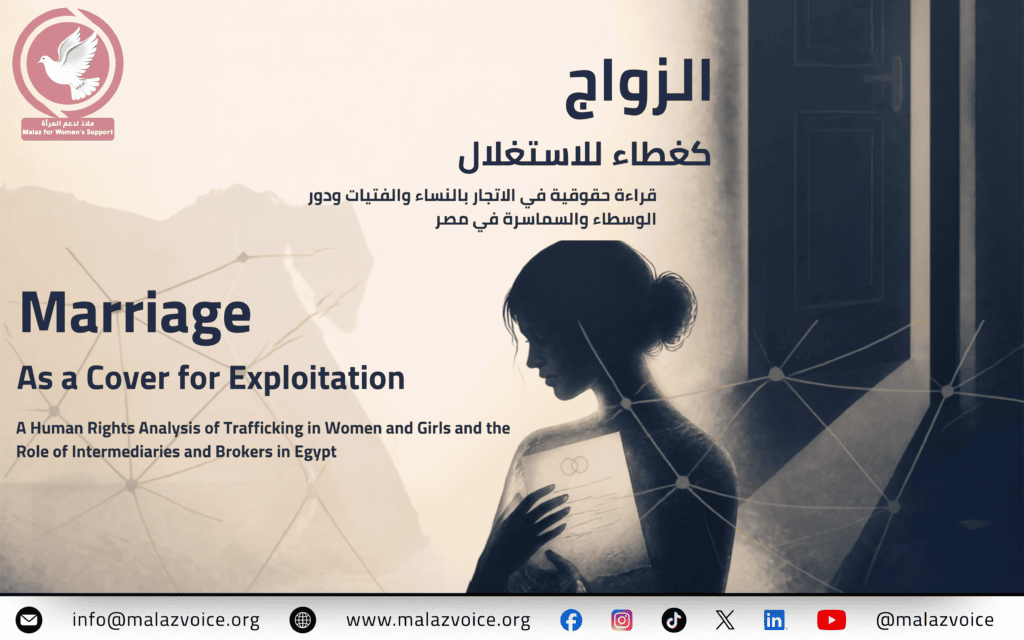
This policy paper examines the phenomenon of temporary exploitative marriage involving women and girls in Egypt as a form of exploitation that may be concealed behind a relationship that appears, on its face, to constitute a marriage completed in accordance with legal procedures. In some cases, however, such relationships may be based on the exploitation of need, poverty, or vulnerability; deception; coercion; control; or the extraction of material benefit from the more vulnerable party. The paper raises a central concern: treating such cases merely as family disputes or marital conflicts may obscure their exploitative nature and result in gaps in protection and accountability.
The paper does not assume that every temporary or short-term marriage constitutes trafficking or exploitation. Instead, it distinguishes between consensual relationships, on the one hand, and relationships in which genuine freedom of choice is absent or a woman’s or girl’s vulnerability is exploited to generate a benefit for another party, on the other. Accordingly, the paper adopts a set of analytical indicators to support a more accurate assessment of the facts. These include: exploitation of poverty, need, or vulnerability; coercion or deprivation of freedom of choice; deception or misrepresentation; exploitation of unequal power or knowledge; control, threats, or blackmail; obtaining material or in-kind benefits through the exploitation of a woman; and the repetition or organization of exploitation in a manner indicating a pattern that extends beyond an individual incident.
The study demonstrates that the risks associated with this phenomenon do not lie solely in certain forms of marriage themselves, but also in the space between the legal recognition of the relationship and the actual circumstances in which it was established, maintained, and concluded. Formal procedures may be fully completed while the voluntariness underlying the relationship remains questionable due to severe poverty, economic need, young age, reliance on an intermediary, misleading promises, significant disparities in power or access to information, or the use of threats and control. Accordingly, formal procedural validity alone is insufficient to rule out the possibility of exploitation.
|
|
|