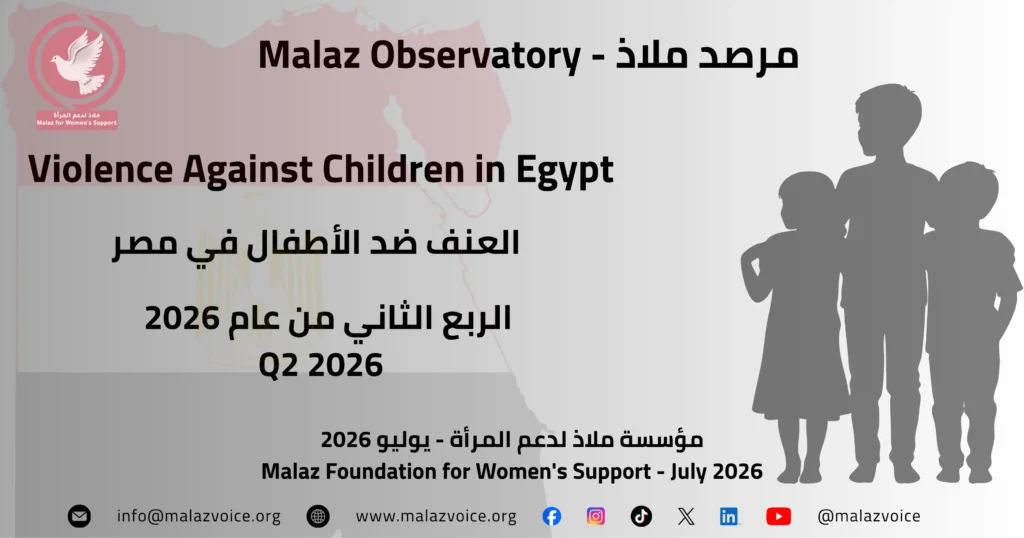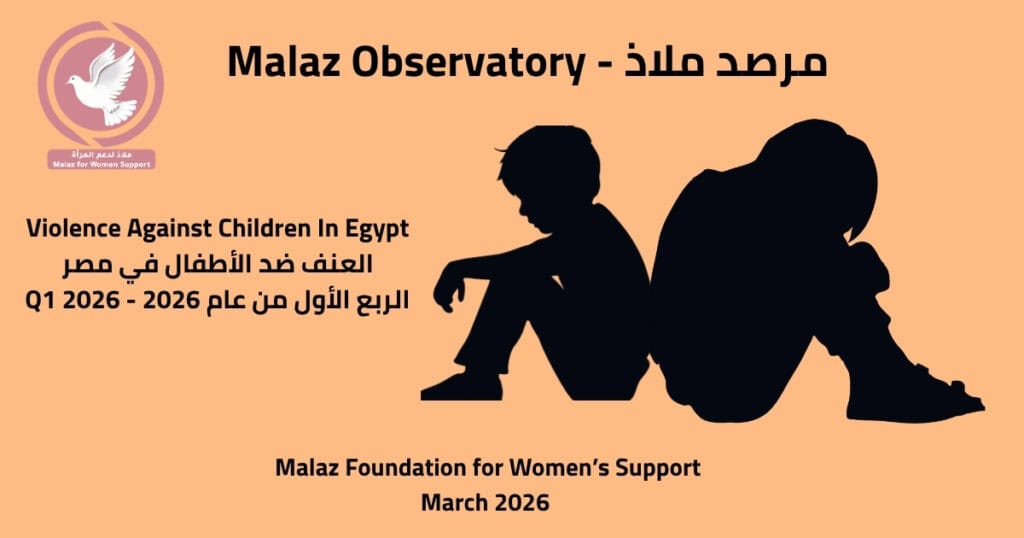
This report, published by the Malaz Foundation for Women’s Support, provides an in-depth analytical assessment of the phenomenon of violence against children in Egypt during the period from January to March 2026, based on the monitoring and analysis of 47 cases documented through media sources and publicly available data. The report aims to move beyond a mere presentation of facts as they are, toward a deeper understanding of the phenomenon of violence against children by analyzing its various patterns, the contexts in which it occurs, its severity, and the social and economic factors that contribute to its persistence and perpetuation. Translated with DeepL.com (free version).
The findings reveal that violence against children in Egypt does not represent a series of isolated incidents, but rather constitutes a cumulative structural phenomenon in which economic, social, cultural, and institutional factors intersect, thereby reproducing violence within multiple spheres, foremost among them the family, which emerges as the context most closely associated with the most severe cases, including murder, physical assaults, and sexual abuse.
In terms of types, physical assaults account for the largest proportion of cases (29.8%), followed by sexual abuse (27.7%), then exploitation (25.5%), while homicides account for 17% of all recorded cases. This distribution reflects that violence against children does not take a single form, but manifests as an overlapping series of patterns of abuse, exploitation, and escalation, varying in severity but belonging to the same generative structure of violence.
|
|
|